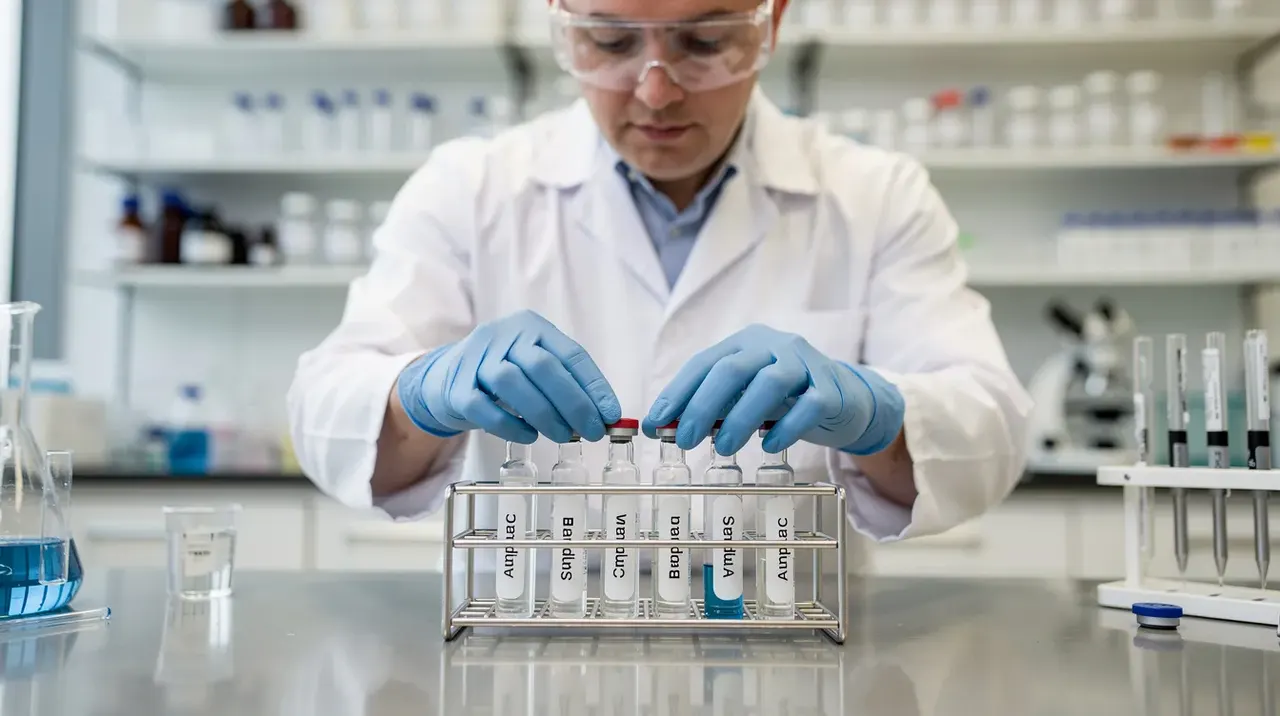
How to reconstitute a lyophilised research peptide: choosing a diluent, working out the concentration and a careful step-by-step bench technique.
Most research peptides arrive as a lyophilised powder that has to be dissolved before use. Reconstitution is simple, but small mistakes — the wrong diluent, a rushed technique, a miscalculated concentration — can waste material or quietly skew results. This guide covers diluent choice, the concentration maths and a careful bench technique.
If you only need the numbers, our free peptide reconstitution calculator works out the concentration for you.
Choosing a diluent
- Bacteriostatic water — sterile water with 0.9% benzyl alcohol as a preservative. It tolerates repeated withdrawals from the same vial, which is why it is the default for most peptides. See bacteriostatic water explained.
- Sterile water — no preservative. Suitable when the whole vial will be used at once.
- 0.9% sodium chloride — used for peptides that are more stable in an isotonic solution, or where benzyl alcohol does not suit the chemistry.
- Dilute acetic acid — occasionally used for peptides that dissolve poorly at neutral pH.
Check the product page or COA for any solubility note before you start. When in doubt, a small test volume tells you more than a guess.
The concentration maths
Concentration is simply the amount of peptide divided by the volume of diluent:
concentration (mg/mL) = peptide in the vial (mg) ÷ diluent added (mL)
Worked examples:
- 5 mg + 1 mL = 5 mg/mL, so 100 µL holds 0.5 mg
- 5 mg + 2 mL = 2.5 mg/mL, so 100 µL holds 0.25 mg
- 10 mg + 2 mL = 5 mg/mL, so 100 µL holds 0.5 mg
- 10 mg + 5 mL = 2 mg/mL, so 100 µL holds 0.2 mg
Two habits avoid most errors:
- Work in microlitres for aliquots. 1 mL = 1,000 µL, so 0.25 mg at 2.5 mg/mL is 100 µL.
- Pick a volume that gives round numbers for the aliquots your protocol needs, rather than the other way round.
The reconstitution calculator does this for any vial size and volume.
Bench technique, step by step
- Step 1 — Let the vial reach room temperature before opening, so moisture does not condense on the powder.
- Step 2 — Wipe the stopper of both the peptide vial and the diluent vial with 70% alcohol and let it dry.
- Step 3 — Add the diluent slowly down the inside wall of the vial rather than straight onto the powder.
- Step 4 — Swirl gently or let it stand until the solution is clear. Do not shake — vigorous agitation can denature some peptides and cause foaming.
- Step 5 — Inspect the solution. It should be clear and free of particles. Cloudiness can mean poor solubility in that diluent.
- Step 6 — Label the vial with the compound, concentration, diluent and date.
Storing reconstituted peptides
Reconstituted peptides are much less stable than the dry powder.
- Store in the fridge at 2–8 °C, protected from light.
- For longer storage, divide into single-use aliquots and freeze at −20 °C or below; avoid repeated freeze–thaw cycles.
- Record the reconstitution date and follow any stability guidance on the product page.
Our peptide storage and stability guide goes into more detail.
What you need
- The peptide vial — for example BPC-157, GHK-Cu or Tesamorelin.
- A suitable diluent, such as bacteriostatic water 10 mL.
- Sterile pipettes or syringes for measuring volumes, alcohol wipes, and labels.
HiPeptides (formerly UKPeptides) dispatches weekday orders placed before 12pm the same day from the UK, with free tracked UK delivery over £50.
For research use only. This guide describes laboratory handling of research reagents and does not describe human, clinical or veterinary use.
Written and reviewed to our editorial standards. Explore the research peptide catalog or read more in Research Notes.
For research use only · Not for human or veterinary use